
Inside Crawford County Property Tax Records
Two offices split the work in Crawford County. The Appraiser sets each parcel's class, appraised value, and assessed value; the Treasurer keeps the bill, payment status, receipts, and prior tax history. Read both sides together. An appraisal-card figure is not an amount due. A paid bill proves neither ownership nor settled title.
| Tax-record field | Meaning | Official source |
|---|---|---|
| Appraised value | The county's value before the statutory class rate is applied | Appraiser parcel card |
| Assessed value | The taxable base produced by appraised value times the Kansas class rate | Appraiser record |
| Class and tax unit | The property category and local taxing-unit context | Appraiser and tax search |
| Bill and balance | Current charge, payment, receipt, and taxes-due status | Treasurer tax record |
| Delinquency history | Unpaid prior taxes and possible foreclosure progression | Treasurer and court records |
Kansas builds the tax in two steps. Appraised value times the statutory assessment rate yields assessed value. Assessed value times the mill levy, divided by 1,000, gives the tax. Each figure answers a different question. A deed's consideration, an appraised figure, an assessed figure, and the bill itself are not interchangeable, and the Crawford County property value guide unpacks those distinctions further.
Search the Crawford Tax Account Precisely
The official Crawford tax-information search bends to almost any starting point. Start with the fewest reliable fields. Use the Search button, not the Enter key, and reset the form before switching strategies so an old criterion does not quietly narrow the next result.
| Search group | Verified choices | Best use |
|---|---|---|
| Tax type | Real Estate, Personal Property, Oil, Gas, Trucks, Minerals, State Assessed Utilities | Keep Real Estate selected for land and buildings |
| Name | Current Owner, Taxpayer, or Both; last name works best | Separate title-name questions from bill responsibility |
| Address | Street number, name, direction, ZIP, subdivision, block, lot | Find a known place or compare a subdivision |
| Parcel keys | Unit, parcel, CAMA components, Quick Ref | Reach one account without name ambiguity |
| Status | Current taxes or statements with taxes due, current or delinquent | Distinguish a current bill from unpaid history |
The official tax search displays its own last-updated date. Treat it as a snapshot, not a schedule. Read the date shown during the current search before trusting any balance or payment status.
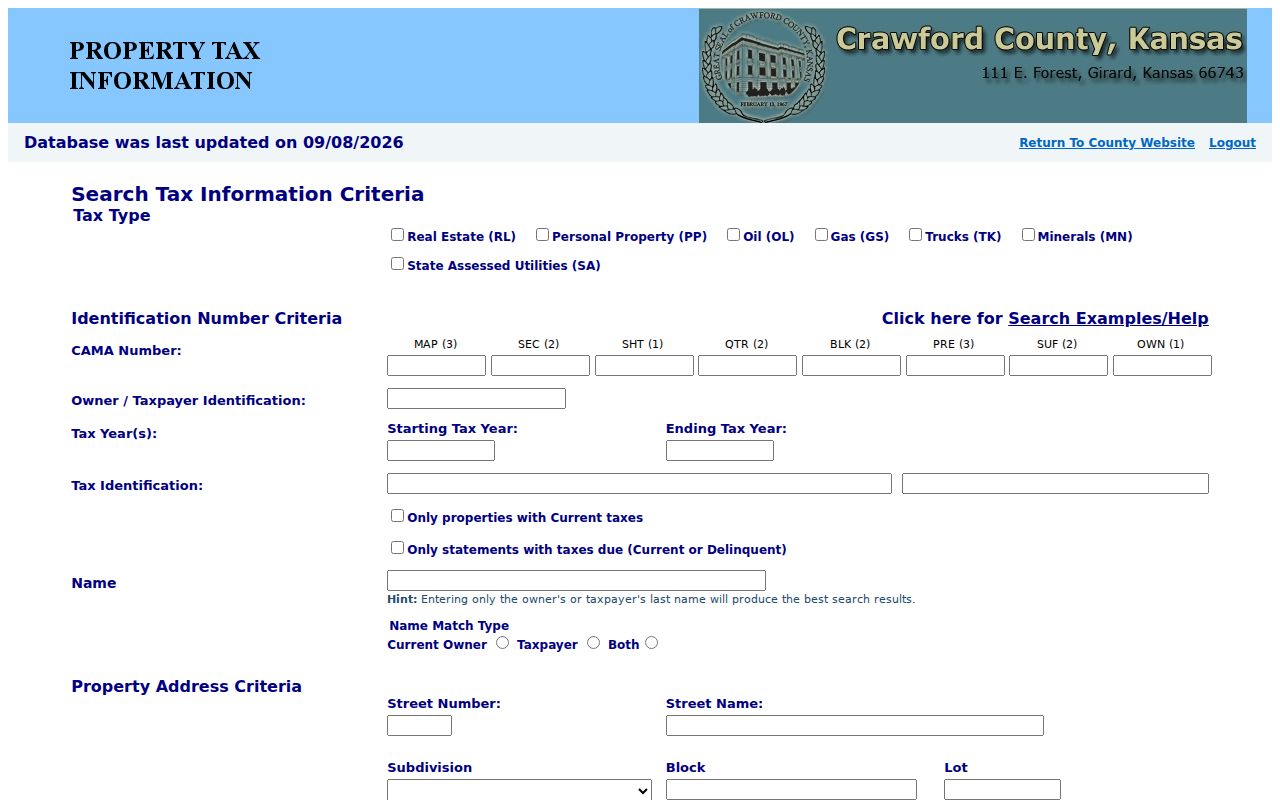
An address, owner name, parcel identifier, legal-description clue, or tax-status filter can each serve as the starting key. The screen lays those fields out plainly.
The Crawford County November Billing Cycle
The county's property-tax calendar puts statements in the mail during the first two weeks of November. One statement carries two stubs. The first half is due December 20. The second half is then due May 10. When either date lands on a weekend, the following Monday applies. Miss the December deadline and the full amount comes due with interest. Delinquent real-estate tax accrues interest, can move into foreclosure after three years, and makes a current balance only one piece of useful Crawford County property tax research. Review prior payment history and sale status too. The county calendar page illustrates the timing.
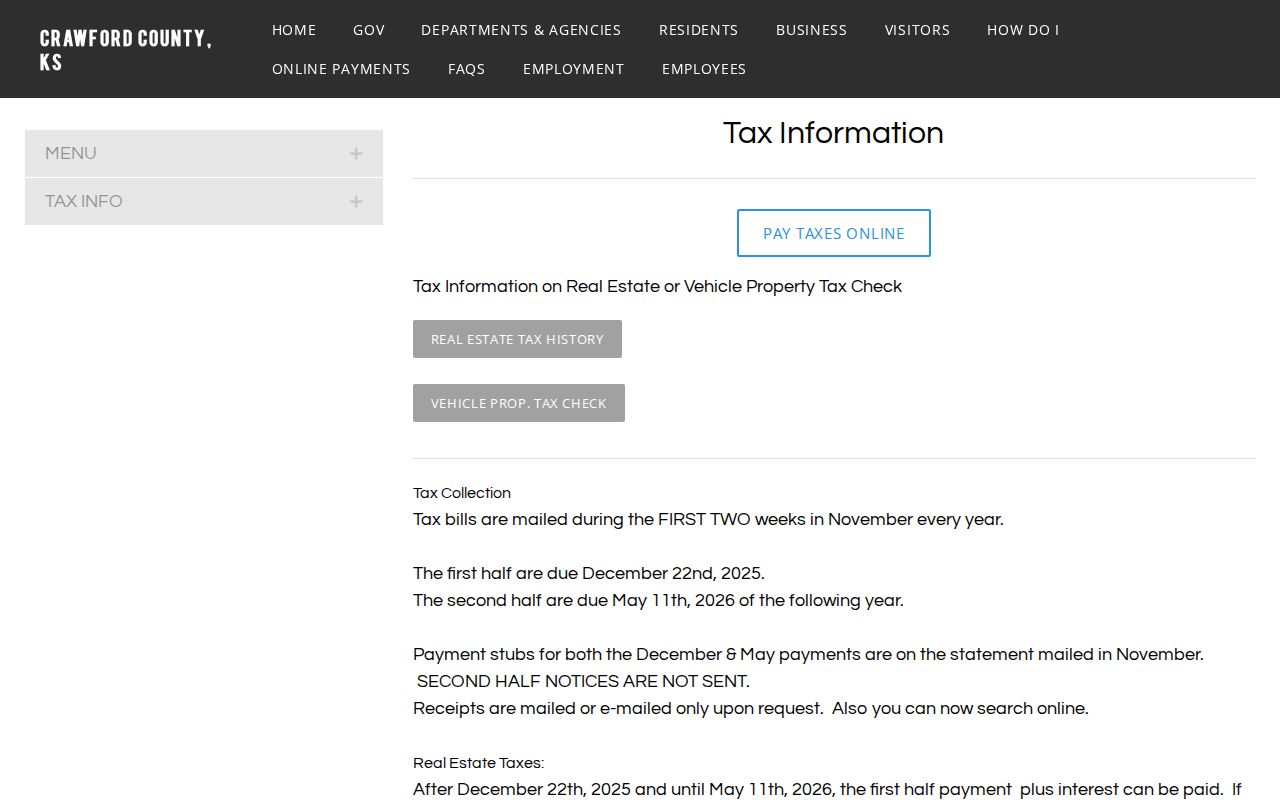
Statutory dates, weekends, and account circumstances can shift the practical deadline. Trust the dates printed on the current statement.
Note: A tax-payment record identifies an account and payer status; it does not replace the latest deed as evidence of ownership.
Look Up a Crawford County Tax Bill
Start with parcel identity, not a name. Then work toward account status and save the current evidence, an order that keeps a bill from landing on the wrong same-name owner or a similarly named road.
- Open the tax search and select Real Estate, then try street number and name or the exact parcel number.
- Match the result by owner or taxpayer, property address, legal description, tax unit, subdivision, block, and lot.
- Read the current charge, taxes-due flag, receipt, and previous payment history through the Treasurer's official routes.
- Compare the account with the Appraiser parcel card for class, appraised value, and assessed-value context.
- If delinquent, check the official foreclosure list and court record rather than assuming a sale has occurred.
- Assessed value
- The taxable base after the Kansas classification rate is applied to appraised value.
- Mill levy
- The rate applied per $1,000 of assessed value to calculate tax.
- Tax relief
- A statutory program or classification that can change liability; eligibility must be confirmed with the responsible Kansas or county office.
- Tax lien
- A public claim arising from unpaid tax; status should be checked across Treasurer, recorded, and court sources.
Treasurer Access Beyond Crawford's Website
The Crawford County Treasurer supports more than online payment. Researchers may use the courthouse counter, mail, telephone assistance, online lookup and payment, receipt lookup, prior history, and the Pittsburg satellite office. The main Treasurer office is at 111 E. Forest Ave., Girard; the county lists 620-724-8222 and weekday hours of 8:30 a.m. to 4:30 p.m.
When writing or calling, provide the parcel number, tax unit, exact owner or taxpayer spelling, property address, tax year, and the specific document or status requested. A narrow request is easier to answer than a request for every available item. KORA may provide an additional route for an existing public record, but the office need not create a new compilation or conduct research.
The Treasurer page shows its payment, receipt, history, contact, and alternate-office routes.
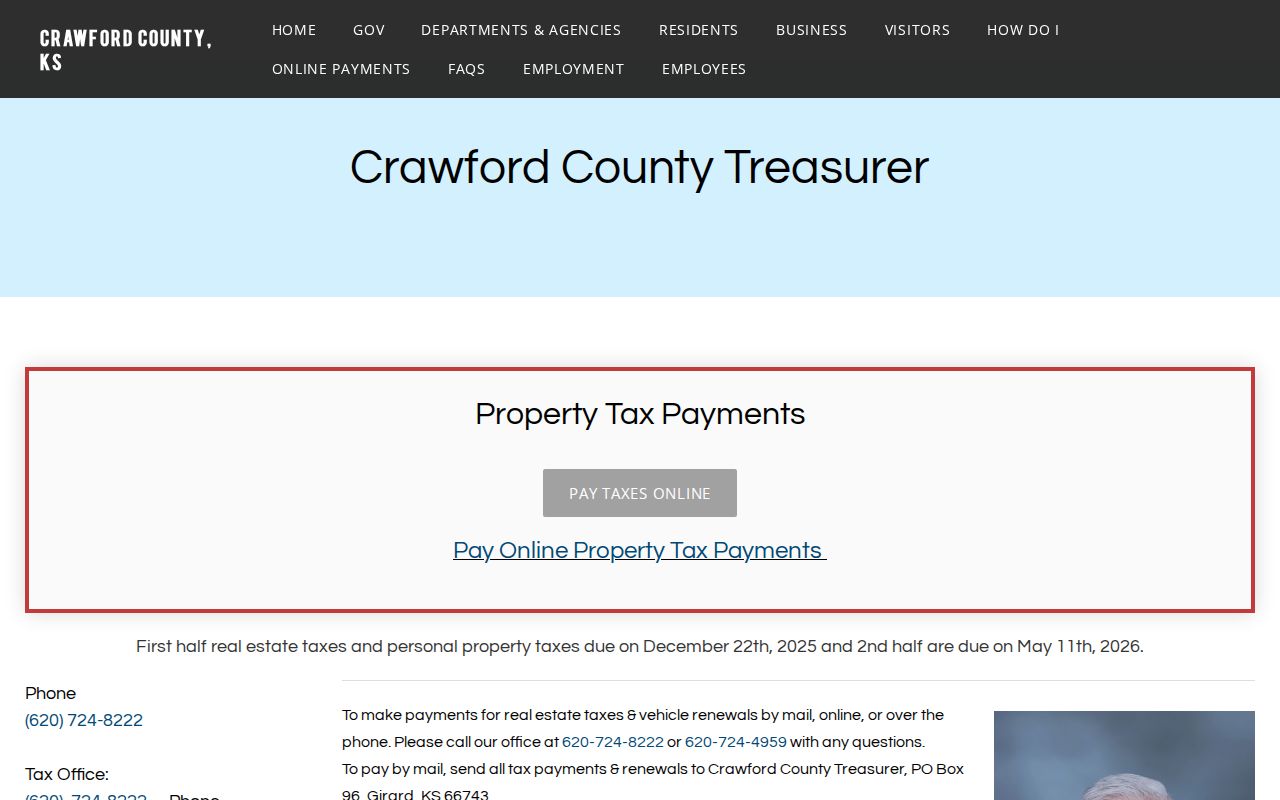
Online results can be unclear or incomplete. The counter, phone, and mail routes matter when a receipt is needed or an older payment does not appear online.
Kansas Class Rates Shape Crawford Assessments
Classification explains why two parcels with matching appraisals can carry different assessed bases. Kansas sets residential property at 11.5 percent. Vacant lots and nonprofit property sit at 12 percent. Commercial and industrial property is assessed at 25 percent, agricultural land at 30 percent of use value, public utilities at 33 percent, and other property at 30 percent. Check the class on the Crawford card first.
Different value clocks. The inspected agricultural card showed use value and land market value side by side; neither figure alone is the tax bill.
One Crawford sample card makes the point sharply. It shows 233.90 acres, 0.00 market acres, a land use value of 54,920, and land market value of 1,039,600 side by side. Those fields serve different statutory valuation purposes, not contradictions.
From Delinquency to a Crawford Tax Sale
The county's tax-foreclosure guide describes a legal process. It is not an instant transfer after one missed bill. The delinquency period comes first. Notice, court proceedings, auction, confirmation, and a tax-foreclosure deed can follow. The official sale-list page announces sales only when scheduled. Property is identified by legal description and county tax ID. Easements, restrictions, and covenants can survive the sale. The county warns that federal liens raise special complications at the confirmation stage. Review the court case, map, recorded instruments, and title evidence before relying on the sale record. The county's published sale guide lays out each stage.
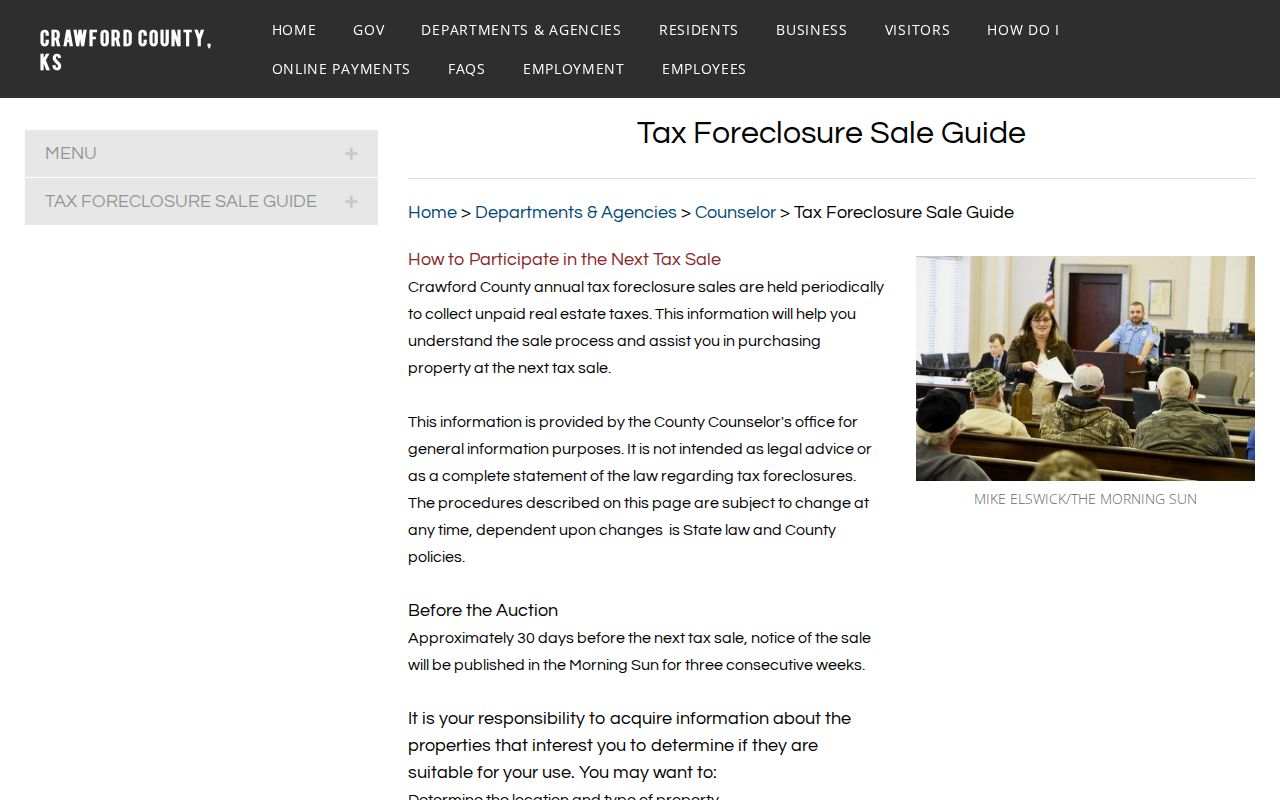
A screenshot can orient you, but it settles nothing. Any live Crawford County tax sale depends on the current notice, the court docket, and the final confirmation record.
Challenge a Crawford County Assessment
Crawford County gives owners two distinct routes for one parcel and tax year. They cannot be combined. An informal meeting with the Appraiser is the first option. It must happen within 30 days after the real-estate notice of value is mailed. The second option is payment under protest. That one is filed with the Treasurer at the time the tax is paid. Personal-property notices follow a May 15 timeline, the county says. For protests, the deadline is December 20 if you pay before that date. When an escrow agent or tax service pays instead, January 31 controls.
Choose one route. A taxpayer cannot use both the notice-of-value appeal and payment-under-protest process for the same property and tax year.
Build your file before any Crawford County appeal: the notice, the parcel number, the prior parcel card, photographs or condition evidence, comparable sales data, and every exchange with the Appraiser. The county publishes no separate local comparable-sales database. Ask the office directly what evidence it accepts rather than assuming a portal result will carry the day. The county's assessment appeal page explains both paths.
Reread the posted guidance each year. Deadlines shift with the notice and payment circumstances of the current tax year. An informal meeting works best when your evidence targets the parcel, the valuation date, and the disputed characteristic itself. Start with the legal description and classification. Then pin down a factual issue. Examples include acreage, the improvement description, condition, or how agricultural land is treated. A tax-bill dispute and an appraisal dispute are not the same thing. Payment questions belong with the Treasurer. Valuation and classification questions belong with the Appraiser. A record may be missing from the online account. The Kansas Open Records Act offers a request route. KORA requires agency action as soon as possible, and no later than the third business day unless the delay is explained. It permits reasonable actual costs and advance payment. It does not force an office to create a new analysis. So ask for a named card, notice, receipt, or existing tax document. Do not ask staff to calculate a fresh result.