
Crawford County Deed Types
Deed records in Crawford County begin with the Register of Deeds in Girard. That office accepts and files each instrument. A deed does three things: it names the parties, describes the land, and records the transfer itself. That sets it apart from a mortgage, a lien, a release, a lease, an easement, or a plat. Those instruments can still touch the same tract. They often sit in the same office trail. The index label alone can mislead. Read the exact filed instrument before drawing any conclusion about what it does.
| Deed Type | What It Does | Common Use |
|---|---|---|
| Warranty deed | Conveys title with stated covenants | Ordinary purchase |
| Quitclaim deed | Releases the grantor's claimed interest | Interest cleanup or family transfer |
| Trustee or representative deed | Conveys under stated authority | Trust or estate transfer |
| Tax-foreclosure deed | Records a confirmed tax-sale transfer | Delinquent-tax proceeding |
| Plat | Files a land division and dedications | Subdivision history |
One deed is only part of the ownership story, never the whole title. The Register of Deeds page identifies the office and the scope of its deed records.
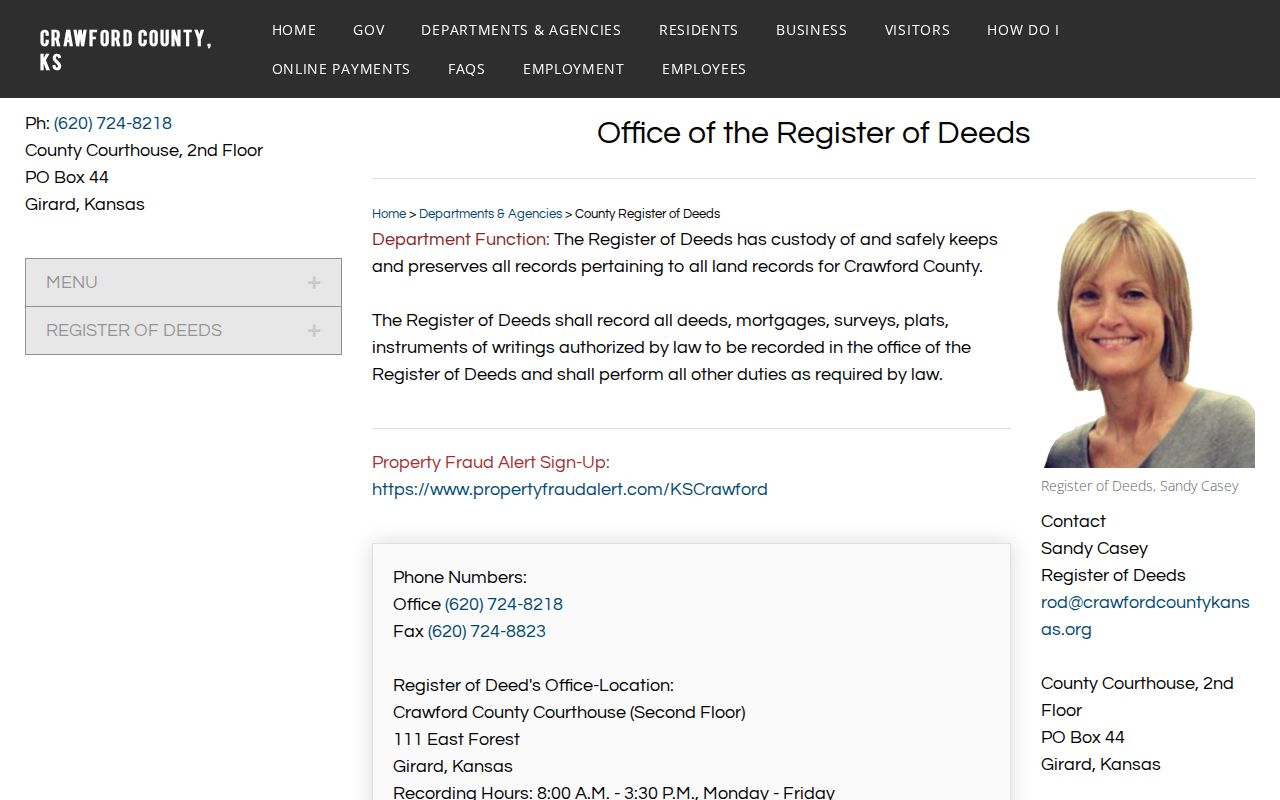
That office page is just an access point. Mortgages, releases, liens, easements, plats, and court orders may still need review.
Use Crawford's Grantor-Grantee Trail
A grantor-grantee index sorts deed records by who conveyed and who received an interest. Start with the assessed owner of record. Note the parcel legal description too. Then work back to that owner's acquisition deed. Match the land text, not the names alone. Crawford County does not publish the earliest online year. Web searches carry an unknown time limit. The paper trail may reach further than the portal does.
- Find the current acquisition deed with the current owner as grantee.
- Read the grantor, date, deed type, legal description, and document reference.
- Search that grantor as a grantee in an earlier period and confirm the same land.
- Repeat until online coverage ends, then continue in deed books and older indexes.
- Grantor
- The party that conveys or releases an interest.
- Grantee
- The party that receives the stated interest.
- Chain of title
- The linked sequence of recorded transfers for one tract.
- Book, page, or instrument
- A reference used to retrieve the recorded document.
Crawford Deed Access Choices
The county's online-services page splits visitors into two groups. Tapestry serves occasional users on a pay-as-you-go basis. Laredo, by contrast, offers frequent users a subscription with real-time data, image printing, and many search parameters. Neither county page states the first online year. A blank portal result therefore cannot prove that an older deed does not exist. The online-services screen simply routes each type of user toward its deed-search path.
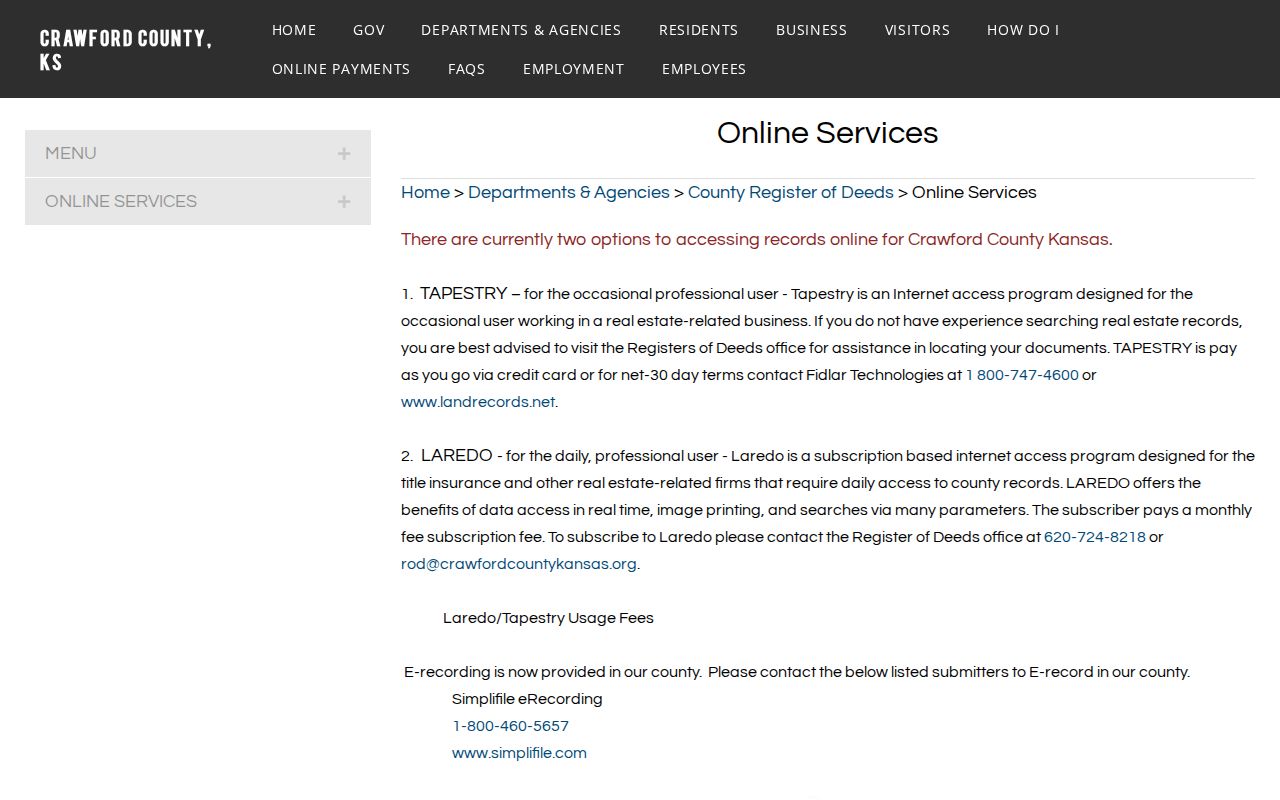
That page is a routing guide. It is not an index result, nor proof that any particular instrument is online. The counter, telephone, written request, and mail remain equally valid channels for deed records. Older work can require deed books and index digging. County genealogy land listings begin in 1870. That starting year must not be confused with online portal coverage.
Search Crawford Deeds with Better Clues
A narrow request succeeds far more often. Gather the parcel number and legal description from CIC. Then list current and prior names, entity spellings, an estimated date, and the likely instrument type. For a platted lot, include the addition, lot, and block. For rural land, keep the section, township, range, acreage, and any quarter-section text intact.
A sample CIC card linked deed references 664-107 and 611-464. References like those work well as retrieval keys, though they are only sample facts. Once an image opens, read the adjoining references and marginal notes. Look for a correction, release, assignment, or earlier deed.
Crawford Recording Rules Shape Results
The Register of Deeds requires originals with legible text of at least eight points, acknowledged or notarized signatures, printed names under signatures, and a complete legal description. A filing also needs the correct fee and space for the recording stamp. A deed generally needs a sales validation questionnaire unless a stated exception applies under K.S.A. 79-1437(a).
Mortgage assignments and releases should cite the original names, legal description, book, page, and date. Assignments also need the assignee's full address. Those rules explain why precise references recur throughout deed records, and why a later release may be indexed apart from the first mortgage.
Crawford Deed Fees by Instrument
The county fee schedule lists $21 for the first page of a deed, mortgage, or other instrument. Each added page or fraction costs $17. A mortgage assignment or release runs $20 for page one and $4 per added page. Town plats cost $32 per page, and certification is $13. These are recording and copy-service figures only, not a promise about third-party portal charges.
Check the current Register of Deeds fee schedule before submitting or ordering anything. Send enough detail for staff to identify the record. Also confirm how payment must be made.
Crawford Plats Extend the Deed Trail
A deed may name a subdivision, addition, lot, or block without showing the layout. The recorded plat supplies the drawing, streets, easements, dedications, and earlier tract context. Girard addition names include Hull's, South Girard, Perry's East, Player's, West, Original Town, and Gaitskill's. Those exact names can unlock deed and plat index searches.
Frontenac's original plat is tied by Kansas Historical Society research to Mine No. 1. It is identified as held by the Register of Deeds. Pittsburg agenda packets can reveal legal descriptions and street-vacation clues. These clues surface before the final county instrument is pulled. A city agenda is only a lead. The recorded plat remains the land-record source.
Crawford Deed History Starts Offline
Crawford County was formed in 1867. Girard won the county seat after an 1868 contest. That is why so many historic land records converge at the courthouse there. County genealogy land listings reach back to 1870. None of that history tells you when recorder images first appeared online. Older work still runs through Girard.
For a deeper chain of title, lean on deed books, alphabetical land listings, county genealogy resources, Kansas Historical Society collections, Pittsburg Public Library materials, newspapers, and obituaries to surface name variants. Treat each source as a clue rather than proof. The filed deed, probate record, or court order is what supplies the legal link.
Monitor Crawford Deed Filings
Crawford County takes part in Property Fraud Alert. Anyone can register a name. They get a notice when a matching instrument is filed against Crawford County property records. Name variants for a trust, estate, or business entity may affect matching. Keep in mind the alert never blocks recording. It also never rules on whether a filing is valid.
If a notice surprises you, pull the deed image. Compare the parties, acknowledgment, legal description, date, and related deed records. Quick review can separate a legitimate document from one that calls for legal help.
Order a Crawford County Deed
Several routes lead to Crawford County deed records. Tapestry serves occasional pay-as-you-go searches, while Laredo suits daily subscription use. The Register of Deeds office handles requests directly at the counter, by telephone, in writing, or by mail. The office sits on the courthouse second floor at 111 East Forest Street in Girard. Its number is 620-724-8218. The Tapestry entry screen is the documented route for an occasional paid deed search.
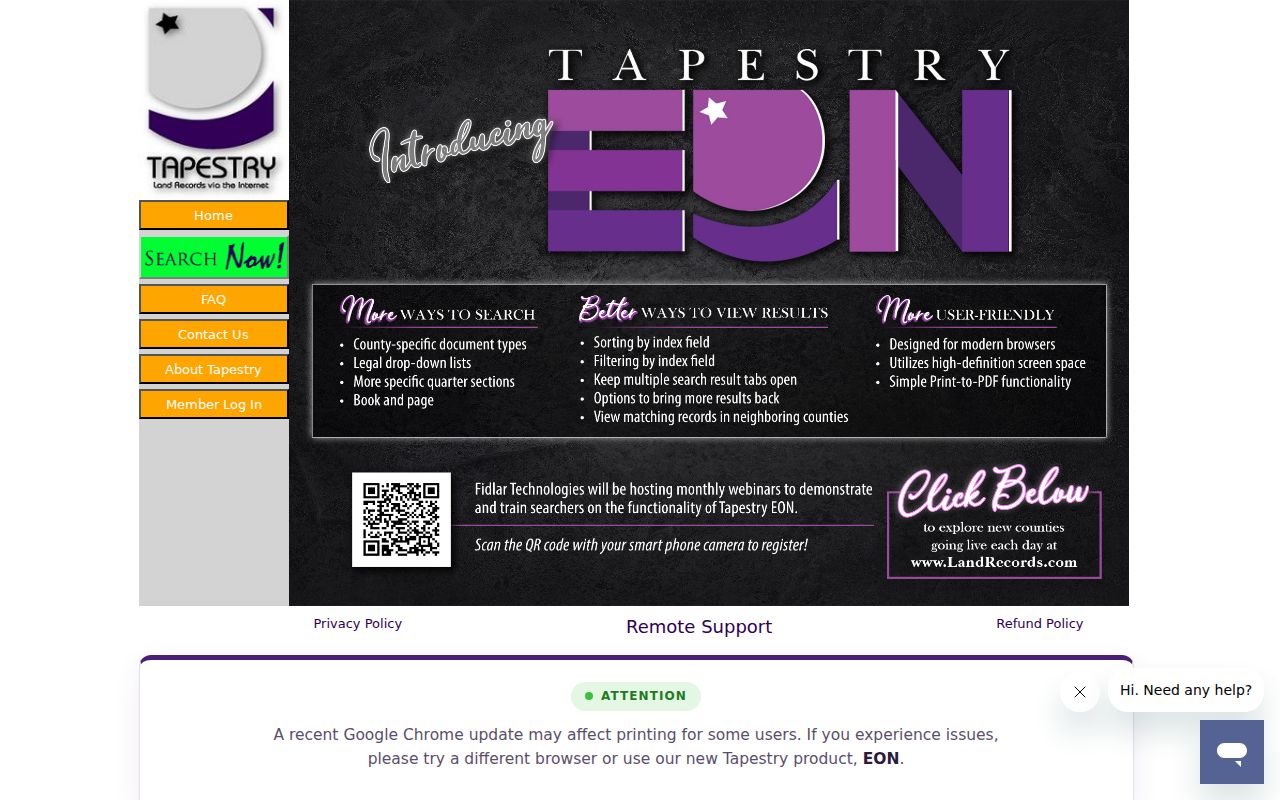
The entry confirms the service route. A Crawford result screen and full index-field inventory are not published. When ordering, give the parcel ID and the complete legal description. Include owner spellings, a date range, and the document type or reference. A certified instrument costs $13 under the county fee schedule. Portal image charges and access terms can differ. The recorder also cautions that staff will not perform broad research. A copy search can miss related documents.
Recorded, not guaranteed. The Crawford deed index shows filed instruments, not all possible rights; it is not a title opinion.
A plain image works for most research. A certified copy carries the recorder's certification for formal use. Certification is billed separately from recording charges. Ask what a quote covers: search time, the image, certification, postage, or portal use. Tapestry and Laredo cannot replace office confirmation. That caution applies when an image is faint or falls outside the online span.
Older deed records need a bridge from today's parcel to the historic index. Start with the current legal description and acquisition deed. Then note each prior book, page, instrument, plat, mortgage, release, and correction along the way. When land was replatted, carry both addition names. Genealogy land listings begin in 1870, but the first online recorder year is not published.
Estate and court events can break a simple purchase chain. A representative's deed may rest on probate authority. A tax-foreclosure deed follows notice, suit, sale, and judicial confirmation. A quiet-title judgment may settle claims before a later deed. Search the Crawford District Court or Kansas Courts Public Access by party and case clue. Then confirm the resulting recorder filing.
Access rights may sit outside the first deed you find. Easements, covenants, plats, road vacations, assignments, and releases can all affect use or explain legal text. Pittsburg agenda packets can point toward plats and streets. But the final county filing controls the land-record trail. ORKA can locate a tract, though its parcel line is not a survey.
Open access is broad but not absolute. The recorder states that its records are open except the Kansas Real Estate Validation Questionnaire and military records. A deed image can be public while a related form is not. Request the named instrument rather than assuming every transaction paper follows one access rule.
Shape the copy request around the fact you need. For a conveyance, provide the document reference or the parties and legal description. For a release, cite the original mortgage and the likely release date. For a plat, include the addition, lot, block, and prior addition names. Precise clues cut down false matches.
Documents submitted for recording also carry details that aid later retrieval. Crawford County requires printed names beneath signatures. It also requires an acknowledged or notarized execution, a full legal description, and contact information. A deed normally includes the sales validation questionnaire unless a cited K.S.A. 79-1437(a) exception applies. Those submission rules explain the different access status. The recorded instrument, its index entry, and the restricted questionnaire may not share one public-access rule.